
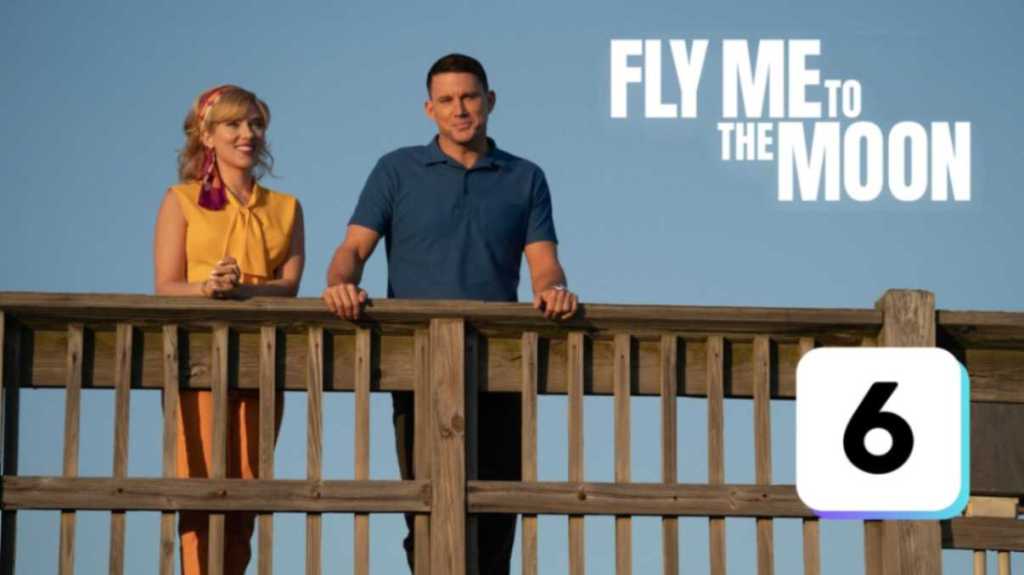

As NASA prepares for the historic 1969 Apollo 11 mission, they bring in Kelly Jones (Scarlett Johansson), a sharp yet morally questionable marketing specialist, to lead the PR efforts. Her task is to boost the agency’s public image, generate excitement, and secure crucial funding before the mission gets the green light. However, she faces resistance from NASA’s by-the-book director, Cole Davis (Channing Tatum), who is focused on ensuring the tragic mistakes of the Apollo 1 mission are not repeated with Apollo 11.
Despite the tension between Kelly and Cole, a romance begins to develop. Their differing approaches to the mission – with Kelly pushing for flashy PR stunts and Cole prioritizing safety and authenticity – put their relationship to the test, as well as the success of one of humanity’s most significant achievements.

Fly Me to the Moon, though only loosely inspired by the real events leading up to Apollo 11, presents a mix of fictional characters and a reimagined timeline. This film faces a common challenge seen in many historical dramas – the balance between entertainment and historical accuracy.
When adapting significant historical periods into a period movie, especially one with a romantic angle, there’s always a struggle to satisfy the demands for both entertainment and realism. Despite taking numerous creative liberties with the true story, audiences expect a film about the space race to be somewhat grounded in reality. This presents an opportunity to educate viewers and honor the events that shaped history.
That said, discussions about engine thrusters and launch trajectories might not appeal to everyone. To make the story more engaging, the filmmakers cast two of Hollywood’s most attractive stars, Scarlett Johansson and Channing Tatum, in key roles at NASA, spicing up the narrative with flirtatious banter and romantic tension.
In some respects, this approach works. The playful exchanges between characters can be entertaining, but the persistent attempt at witty, snappy dialogue in every scene becomes tiresome, reminiscent of the Marvel Cinematic Universe at its worst. However, the format does allow the standout members of the cast to shine.
Jim Rash, playing Lance Vespertine, brings an infectious diva-like energy to every scene, making those without him feel dull by comparison. Ray Romano delivers a nuanced performance as Henry Smalls, a NASA staffer, showcasing the charm that made him a beloved figure in the late 90s and early 2000s. Meanwhile, Woody Harrelson plays Moe Burkus, the government agent who recruits Kelly. Harrelson sticks to his usual persona, but in this case, it’s a classic example of “if it ain’t broke, don’t fix it.”

The main issue with Fly Me to the Moon lies with its leads. From the trailers alone, it’s clear why Scarlett Johansson and Channing Tatum were chosen for their roles. Both are well-known for their work in romantic comedies, action, and drama, making them the obvious choice to attract audiences to a NASA-themed film with a romantic subplot. However, despite their individual star power, the chemistry between the two falls flat. While they manage to elicit a few chuckles, their on-screen relationship lacks the spark needed to make the romance believable. The wooden performances in scenes meant to be full of banter, humor, and heartfelt moments leave viewers wondering if other actors might have done a better job.
For those not enamored with the idea of watching two of Hollywood’s most attractive stars in a NASA story, Fly Me to the Moon still offers a visual treat. The vivid costumes, massive control room consoles, and retro editing montages evoke a charming nostalgia for the 1960s.
However, the film’s aesthetic appeal doesn’t fully compensate for the underlying conflict between Cole and Kelly. Their clash over logistics and staying true to the mission versus the need for PR spectacle feels like a bold metaphor for the film’s own struggle between creating compelling drama and relying on jokes and star power.
The latter half of the film shifts more toward drama, focusing on a fabricated storyline about faking the moon landing – a significant departure from what actually happened in 1969. While this twist offers an entertaining mix of jokes, dramatic tension, and even a cat, it risks spreading misinformation despite the film’s clear jabs at conspiracy theorists.
Produced by Apple Studios, Fly Me to the Moon is set to arrive on Apple TV+ following its theatrical release. In hindsight, this is likely where the Channing Tatum-Scarlett Johansson rom-com belongs.
Packed with a few standout performances, some moderately entertaining humor, and a nostalgic 1960s vibe, Fly Me to the Moon is best enjoyed as a light, brain-off flick for a cozy Sunday night on the couch. While there are moments of genuine intensity, like Cole Davis’ (Tatum) guilt over the loss of the Apollo 1 astronauts and his efforts to avoid similar mistakes, the film ultimately settles for surface-level romance and humor instead of delivering a gripping biographical drama.
Sign up to our newsletter – get notified any time there’s a new post, review or article that may pique your interest.






Leave a Reply